
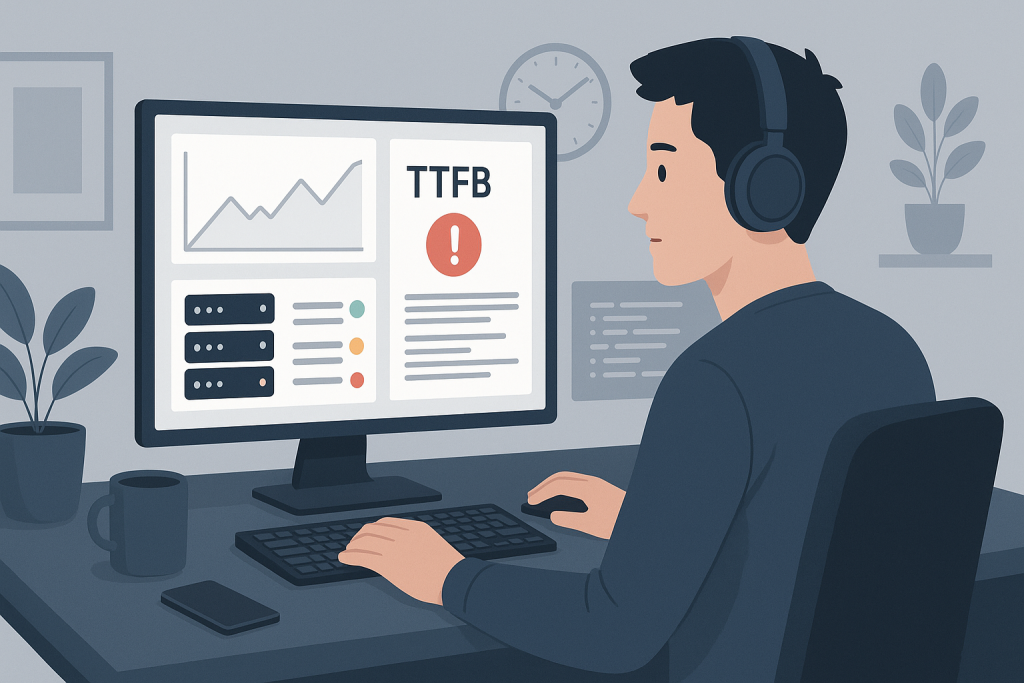
why is ttfb so slow ? Time to First Byte measures the time from requesting a resource until the first response byte begins to arrive. It includes DNS lookup, connection setup, TLS negotiation, network latency, reverse proxies, queue time, and application processing. A high number does not automatically mean the same problem on every site, so the work should begin by separating network delay from origin processing.
Understand what the measurement includes
Lab tools often report one combined TTFB value, but several layers contribute to it. DNS, redirects, CDN routing, TLS, origin distance, server queueing, PHP execution, database queries, session startup, and external API calls can all add time before the first byte.
Compare cached and uncached requests
A cached homepage may be fast while logged-in pages, checkout, search, or API requests remain slow. Test anonymous users, logged-in users, cache hits, cache misses, query strings, cookies, mobile variants, and direct-origin requests.
Separate network latency from backend time
Test from multiple regions and compare edge timing with origin timing. If local origin requests are fast but remote tests are slow, DNS, routing, TLS, or geographic distance may be important. If local requests are also slow, investigate the application and database.
Profile PHP or application execution
Slow middleware, hooks, plugins, template rendering, object hydration, session locks, and external HTTP calls can delay output. Use profiling and application logs to find the longest operations instead of assuming every delay comes from hosting.
Review database behavior
N+1 queries, missing indexes, large joins, lock waits, slow search queries, and repeated option or metadata lookups can all increase backend time. Measure query count and duration on the affected URL.
Check worker capacity and queue time
Even efficient code becomes slow when every PHP-FPM worker or application worker is occupied. Requests wait in a queue before execution starts. Review worker saturation, process duration, database connections, and traffic spikes.
Inspect redirects, CDN, and proxy layers
HTTP-to-HTTPS, apex-to-www, language redirects, authentication redirects, and repeated canonical redirects add latency. CDN cache rules, origin shielding, bot checks, and proxy retries can also affect the first byte.
Fix the largest verified bottleneck
Do not install another optimization plugin without evidence. The right fix may involve page cache, object cache, database indexes, code changes, worker tuning, CDN configuration, fewer redirects, or replacing a slow third-party API.
A practical measurement sequence
Test the same URL several times from the same location and record DNS, connect, TLS, wait, and total time. Then bypass the CDN, test the origin locally, compare a cache hit with a cache miss, and repeat while logged in. Review application timing, database queries, worker saturation, and external calls for the slow request. Consistent measurements are more useful than one PageSpeed result because they show which layer adds the delay and whether the problem is intermittent.
Related technical support
If this issue affects a live website, store, application, or business-critical workflow, the following service pages provide the most relevant support path.
Conclusion
why is ttfb so slow should be resolved by identifying the actual failure path, applying the smallest safe fix, and verifying the workflows that matter to users and the business.
Frequently asked questions
What is a good TTFB?
It depends on location and stack, but consistently low server response time is more useful than chasing one isolated lab number.
Can a CDN improve TTFB?
Yes for cached content and geographic latency, but it cannot fully hide a slow uncached origin.
Can database queries cause slow TTFB?
Yes. Slow or excessive queries can delay the application response.
Why is TTFB fast for one page and slow for another?
Different pages can have different cache states, queries, plugins, templates, and external calls.