
When a website goes down, customer uncertainty can spread faster than the technical problem itself. Visitors may wonder whether an order went through, whether their payment was taken, whether their account data is safe, or whether they should try again later. A short, accurate update can prevent duplicate support requests, reduce abandoned purchases, and show that the issue is being handled.
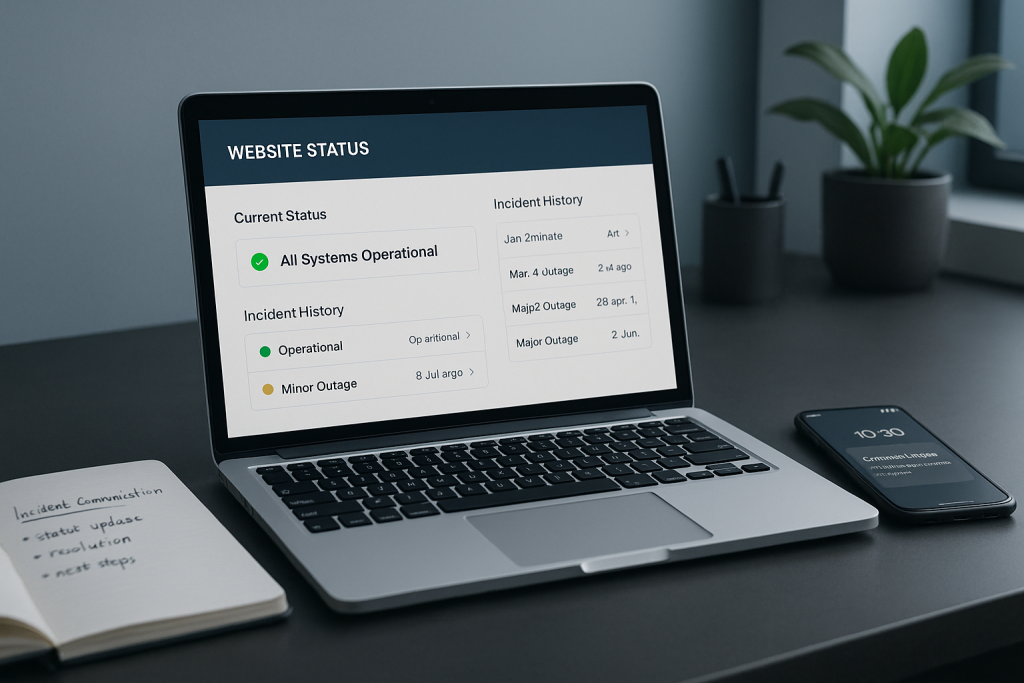
Website outage communication is not about making promises before the cause is known. It is about acknowledging the disruption, explaining the immediate customer impact in plain language, and giving people a reliable place to check for updates. While communication is underway, the technical priority is to restore the affected service safely. If your site, checkout, administration area, or a business-critical workflow is failing for live users, Emergency Website Bug Fixing can help address the underlying issue.
Why website outage communication matters
Silence creates a vacuum. Customers will fill it with assumptions: that the business has closed, their transaction failed, or their personal information is exposed. Even a basic status message gives them context and directs them away from repeated refreshes, duplicate form submissions, and unnecessary payment attempts.
Good communication also gives the team room to work. If support staff have one approved message and a single place to point customers, they do not need to improvise explanations while developers investigate. That reduces the risk of inconsistent claims, such as saying a payment was unsuccessful before order records have been checked.
The aim is not to make the outage sound smaller than it is. The aim is to be calm, specific about what customers should do, and disciplined about what is still unknown.
Decide whether customers need an immediate update
Not every internal warning needs a public announcement. A brief issue affecting a nonessential back-office screen may be resolved before customers notice. Public communication becomes important when people cannot complete an expected action or may make decisions based on misleading site behavior.
Send an initial update promptly when any of these are true:
- The public site is unavailable, showing errors, or loading only intermittently.
- Checkout, payment, booking, login, account access, or a lead form is failing.
- Customers may submit the same order, payment, or request more than once.
- A live campaign, launch, event, or deadline is driving active traffic.
- The issue is likely to continue long enough for visitors to contact support or post publicly.
A useful distinction is between an inconvenience and a blocked customer journey. A minor visual defect may not need a public notice. A failed payment flow, unavailable account portal, or site-wide error generally does.
Use one source of truth for updates
Choose one location as the authoritative status channel. This may be a hosted status page, a pinned social post, an email update for affected customers, or a temporary message on an alternate landing page. The right choice depends on what remains available while the main site is down.
The important part is consistency. Every support reply, social response, and internal update should point to the same source. Do not create multiple posts with different timings or estimates unless they are all updated together.
If the website is partly available, place a concise notice in the affected area. For example, a store can keep product browsing available but show a checkout notice that asks customers not to retry payment until an update is posted. If the entire site is unavailable, use channels that do not rely on the broken site.
What an initial outage message should include
Your first message does not need a root cause. In fact, naming a cause too early can cause problems if later evidence points elsewhere. Focus on facts that are already confirmed.
- Acknowledgement: Confirm that you are aware of the issue.
- Customer impact: State what is currently unavailable or unreliable.
- Action: Say that the issue is being investigated or worked on.
- Customer guidance: Explain whether people should wait, avoid retrying, use another channel, or contact support with specific details.
- Next update: Give a time for the next update, even if there is no restoration estimate yet.
Here is a general-purpose template:
“We are aware that some visitors are currently unable to access our website or complete [affected action]. Our team is investigating and working to restore normal service. Please avoid submitting the same request or payment more than once. We will post another update by [time and time zone]. We are sorry for the disruption.”
This wording is useful because it does not speculate, it gives customers a practical instruction, and it establishes when they should expect to hear more.
Adapt the message to the affected journey
Generic updates are better than silence, but the most helpful notices address the customer’s actual concern.
When checkout or payments are affected
Customers need to know whether to retry and what happens if they see a bank or card authorization. Avoid stating that no one has been charged unless payment records confirm it. A safer message is:
“We are investigating an issue affecting checkout. Please do not submit another payment if you have already placed an order or received a payment confirmation. If you are unsure whether your order was received, contact us with the email address used at checkout.”
When login or account access is affected
Tell customers that access is temporarily unavailable and provide an alternative for urgent requests. Do not imply a security incident merely because login is broken. If there is a confirmed security concern, follow the appropriate incident and legal process rather than making broad assumptions in a routine availability update.
When contact or booking forms are affected
Give an alternate route that is actually monitored, such as an email address or phone number. State whether messages submitted during the affected period may not have been received, so customers know whether they need to send them again.
Set an update rhythm, not a guessed restoration time
Early in an incident, a precise “back online by” time is often a guess. Missed estimates damage trust and can pressure technical teams into risky changes. It is usually better to promise the time of the next communication, not the time of resolution.
For a serious ongoing outage, update at predictable intervals. The interval should be realistic for the team and proportionate to the impact. If nothing has materially changed, say so. A brief message such as “Investigation is ongoing; the affected service remains unavailable; our next update will be posted at…” is still valuable.
Each update should answer three questions: What is the current impact? What should customers do now? When will they hear from you again?
Keep technical investigation separate from public wording
Technical teams need logs, deployment history, server details, error messages, and a controlled way to test a fix. Customers need a simple explanation of the service impact. Mixing the two can lead to confusing updates or expose unnecessary implementation details.
Internally, keep a clear record of when the issue began, what changed shortly beforehand, which services are affected, and who owns customer updates. Externally, avoid naming a plugin, hosting provider, code library, or individual as the cause until the facts are verified. This is not evasive; it is responsible communication during an active investigation.
How to communicate restoration
Do not announce success the moment a fix is deployed. First, verify the real customer journey. Check the affected pages or actions in a normal browser session, confirm key transactions where relevant, and allow for caching or delayed background processes that could make the issue appear fixed only in one environment.
Once normal operation is confirmed, post a concise restoration update:
“The issue affecting [service] has been resolved, and we are monitoring the service. If you experienced a problem during the outage, please try again. If you believe a payment, order, or request was affected, contact us with [relevant reference]. We apologize for the disruption.”
For payment, order, or data-related incidents, follow up directly with customers whose transactions need manual review. A public “resolved” notice does not replace checking for incomplete orders, duplicate submissions, or messages that did not arrive.
Site down or critically broken?
Start with two parallel actions: communicate the confirmed impact to customers and protect the affected workflow from further mistakes. For example, ask customers not to retry checkout if duplicate orders are possible, or direct urgent enquiries to an alternative contact method. Then focus technical work on finding the actual failure and verifying the repair before declaring the incident over.
A clear, measured message will not restore a failed site by itself, but it can reduce avoidable harm while restoration is in progress. When customers know what is happening, what they should do, and when they will hear more, an outage is easier to manage even before the fix is complete.